
The trampoline question.
Are they the devil or actually really useful for leakage? And how do you help leaking with jumping, anyhow?

Pelvic floors and trampolines have a storied, torrid history.
SO many personal stress incontinence origin stories begin with “I was at a birthday party at a trampoline park…” You know the end of this story.
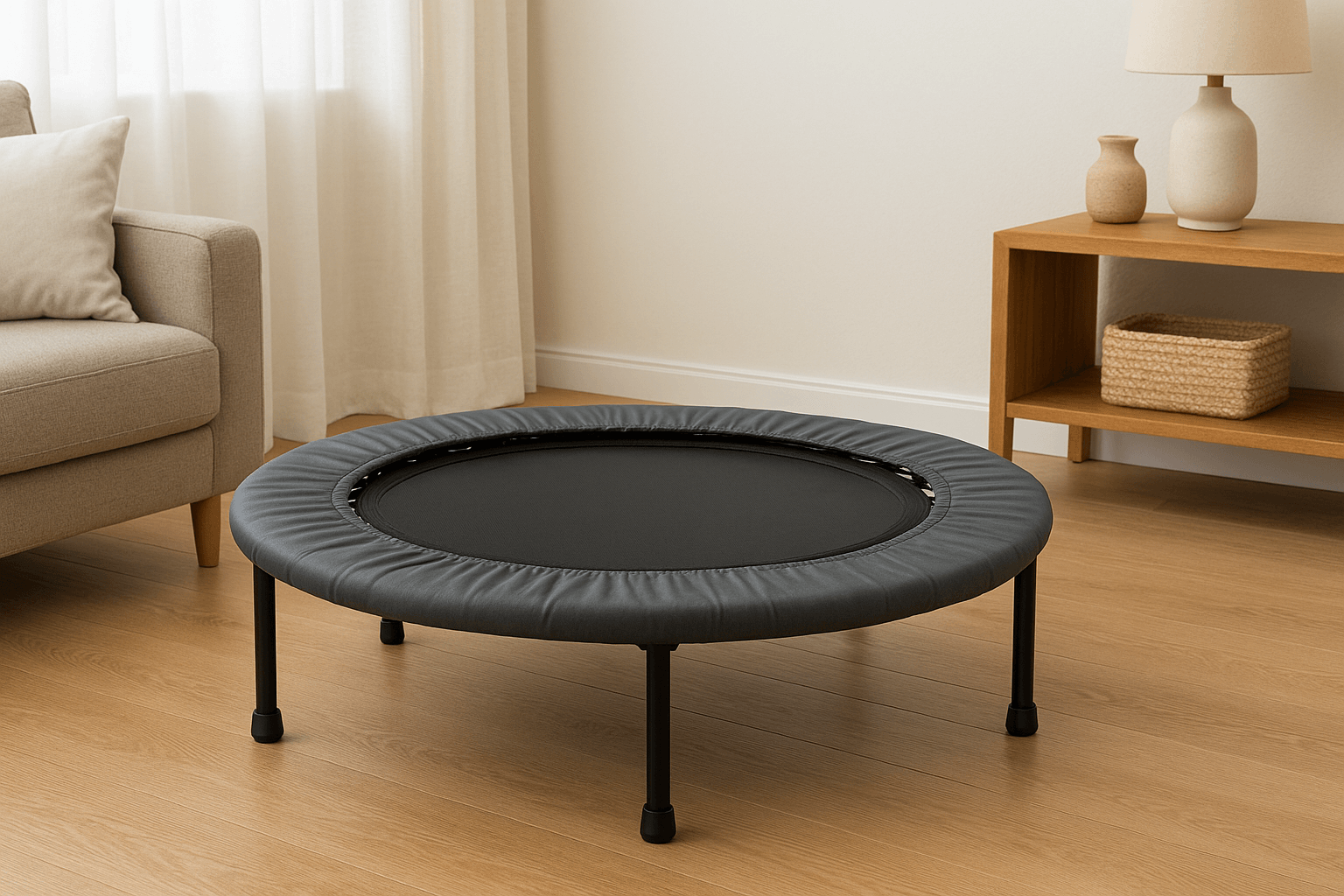
We pelvic floor therapists also love to compare the pelvic floor itself to a trampoline, and I think it’s worth starting here: A good trampoline (read: a functional pelvic floor) is both strong and resilient. If it’s too stiff, i.e. made out of wood, it’s a bad trampoline. A silken trampoline is also not going to work. Both are the cause of stress urinary incontinence (SUI), and a wooden trampoline can also get you to urge incontinence (UUI) and pelvic pain, too.
In the wellness space, there are a million grifters trying to sell you their proprietary methods to “heal your pelvic floor”. This is bullshit, of course. Bodies are different. Brains are different. While there are some universal things that matter, how this manifests will never be in a direct, “take as directed” protocol of any stripe.
Rebounders, or mini trampolines, are one such claim. But that doesn’t make them bad.
So today, we’re going to figure out if mini trampolines (I’m going to use the terms interchangeably) are absolute gold or trash, as well as give some no-equipment tips on how to work on jumping/impact-induced incontinence.
Here’s the tl;dr:
In the literature, there is a huge difference between the performance athletics of a big trampoline and at-home mini trampolines.
Clinically, I’ve seen rebounders be a great way to train for shock distribution in higher level activity (e.g. running, jumping, etc.).
Jumping related SUI can be supported through a series of good old fashioned single leg strength and — importantly — training the pelvic floor to reflexively respond to impact.
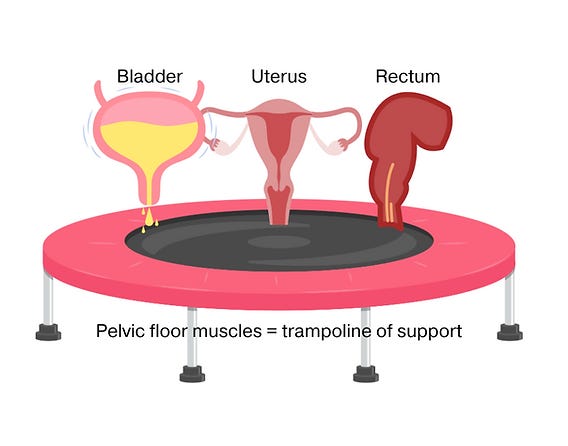
THE analogy. Source: Maria Montessori Schule
Related reading:
“I pee myself every time I sneeze!” All about stress urinary incontinence and why it can happen!
The many stripes of peeing your pants. SUI isn’t the only player in town! You can pee yourself in so many different ways!
Is running evil for your pelvic floor? Since we’re talking about high impact activities today, I’d be remiss if I didn’t talk about running! This is my hallmark article, but I’ve written about how to make running suck less and associated movement tutorials a bunch.
The deep dive:
Let’s begin with the obvious: If you are one of the many people who experienced the seemingly postpartum and/or postmenopausal (and sometimes neither!) rite of passage of going to a trampoline park, jumping with joy, and spontaneously pissing your pants only to swear off trampolines, you are not alone.
My favorite aunt excitedly sent me a picture of the famous Why Mums Don’t Jump a few years back when visiting Ireland. I sent her a thumbs up. A ban on maternal jumping is in the culture, for sure.
The literature supports this: research on professional trampolinists (yes, this is a thing) show that about 80% of those studied have significant urinary stress incontinence. This is because, despite excellent pelvic floor strength(!) the demand of the jump was more than the athletes could counter.
This point holds when looking at gymnasts, too: one review found that gymnasts who specialize in “artistic” gymnastics and trampoline formats leak about 95% of the time during training. Ninety five percent is not an anomaly!
I’ve treated professional gymnasts and circus artists and can attest that those have been some of the most severe incontinence cases I have ever seen.
While most of us are not professional athletes bounding at incredible speeds, the through line of exceptional (perhaps too much?) demand for high volume, high speed jumps holds to most of us lay folk. The demand of repetitive, high stress impact is too high for most of use mortals, and increases risk and incidence for stress urinary incontinence.
And listen, bodies are different. If you love being on a big-ass trampoline for eight hours a day, who am I to tell you how to live your life? But we do know that it is a legitimate risk for the pelvic floor because of aforementioned astronomical mechanical demands. We’re just not designed to jump ten feet in the air for hours on end from an evolutionary perspective, so it makes good sense to me that our pelvic floors collectively lift a middle finger to the idea.

Which brings us to the mini trampoline.
Rebounders/mini trampolines are not Olympic gymnastics, nor are they the gigantic trampolines at your kid’s sixth birthday party. These are small-ish things that could theoretically, if not conspicuously, reside in your living room. You simply can’t jump as high on them, and therefore the force anyone generates is significantly lower.
The small amount of literature on rebounders for pelvic health is relatively positive, albeit scant. This study in postmenopausal women found that regular rebounding reduced SUI rates and this study found that in “healthy” assigned female at birth folks who don’t experience SUI, mini trampolining elicited reflexive pelvic floor sEMG muscle activation, similar to that of regular-degular jumping.
The important take away here, IMO, is that the pelvic floor needs to reflexively respond to a jump, no matter how it happens, in order to stay continent. Personally, I have found that the best way to train for jumping is to… jump. Gradually. Progressively. Supporting deep core and pelvic floor reflexive activation. And the rebounder is just as good a way as any other. Maybe a little flashier and fun, if you’re into that kind of thing?
It’s not a lot of evidence, tbh. I personally own and like my rebounder (and I strongly recommend getting them used!). They make me feel like a 90s group exercise queen, and reduce my Ritalin-induced 4 pm rage in ten minutes with incredible efficacy.
I genuinely like training folks with SUI on mini trampolines because I find that lots of folks are hella rigid in their abdominal canister due to a general lack of movement, tough breath mechanics, and overall bracing for the world.
When we land with a rigid canister, it’s like that wooden trampoline — we leak!
The rebounder, then, is an opportunity to train shock distribution in different joints (i.e. land softly with bent knees and ankles — it’ll change your life) while eliciting that necessary reflexive pelvic floor muscle recruitment.
The nice thing is that you can keep your feet on the surface of the rebounder the whole time in the beginning, therefore making it super accessible and progressive. You can then work up to tiny jumps, big jumps, single sided jumps, jumping jacks, running, the works!
Here’s the take-home:
Do you need a rebounder to resolve SUI? That’s a hard no.
Like everything else, a mini trampoline is a tool. It’s a fun tool, a toy, if you will, and I am personally a sucker for toys. I think rebounders have true therapeutic value, and there are also some studies showing promise for bone density. But you do not need one. Not by a long shot.
Here are some simple strategies to build shock distribution and reflexive pelvic floor engagement with minimal equipment (okay, you’ll need a wall):
Stand in front of a wall a little more than an arm’s length away, and place your hands on the wall at shoulder height (so you’re falling into the wall, basically). Bend your knees and hinge your hips back, then exhale and press into the wall. Did you feel your belly engage? If so, you’re on the road, boo boo!
From here, lift your heels and quickly drop them down. When you drop, allow your knees and ankles to bend generously — that’s shock distribution. You’re landing in a bouncy squat, basically. Be sure not to hold your breath!
Add speed, reps, or make it more challenging by actually jumping (first straight up and down, then in a tiny jumping jack, progressively going wider and wider apart). When you jump, do your best to land softly and as silently as possible (once again, bend knees and ankles generously).
You can also play with pushing into the wall more to support and encourage reflexive deep core engagement — your pelvic floor will come along for the ride!
You can also move away from the wall and hold a light weight about six inches in front of your belly button to progressively work into a world of jumping without walls!
Want to make this both harder and reduce the likelihood of leaking while working on this? Lucky for you, I made this five minute down dog jumping sequence that kicked my ass! Normally I reserve video content for paid subscribers, so if you like this one, consider it a taste test!
I also wrote a more intensive set of training options here that build on what I’ve mentioned above!
If these strategies feel overwhelming to your system, it might be worth looking into intra-abdominal pressure management, glute and lower body strength, and deep core connection.
As always, I am rooting for you. Drop a comment below or feel free to respond to this email. I love hearing from you!

Adventures in Vaginas (and other parts) is my labor of love, dedicated to you.
If you want to support my work and mission to expand access to quality pelvic health education that is gender inclusive and shame-free, please consider sharing this post or becoming a paid subscriber.
To learn more about my 1:1 practice and request a free 15 minute consultation, click here.
Ooh this one was fun! I've sworn off jumping for a different reason and am trying to get back into it. This was a fun way to play around with it!
I really appreciate your cues to get curious and just play and experiment. It makes me way more likely to stay engaged!
Thanks for this in-depth read, Cait.
Would you say that there is benefit to be had outside SUI as well, as in hypertonicity post pelvic floor?